
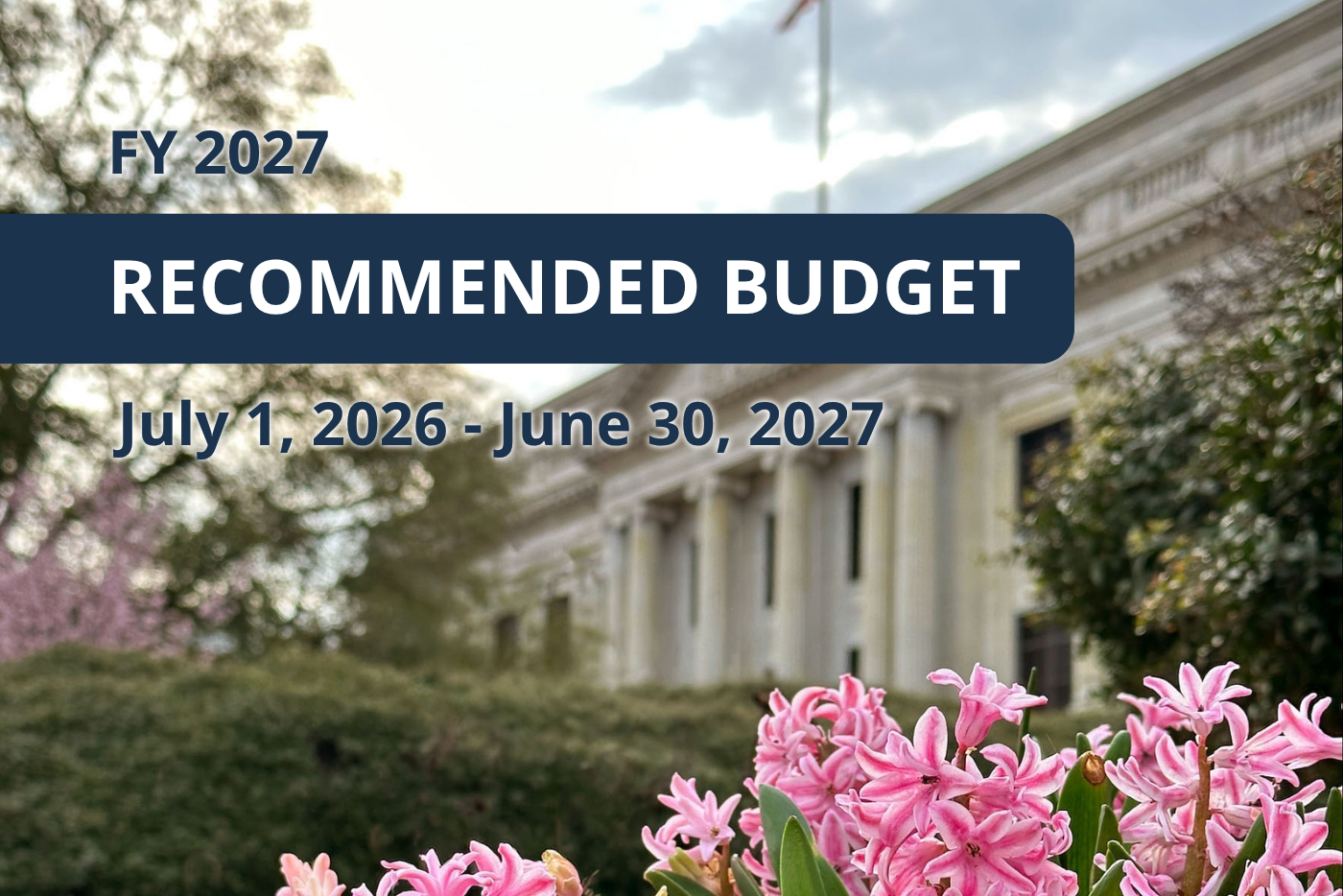
Guilford County Manager Victor Isler presented his recommended Fiscal Year 2026-2027 (FY2027) budget to the Board of County Commissioners (BOCC) during their regular meeting on Thursday, May 7.
The County Manager’s recommended budget totals $1.1 billion with a General Fund total of $935,455,000. The recommended balanced budget recognizes the county's continued population growth, support for education, the greater need for core county services, economic uncertainty and cost of living pressures on residents. The manager’s recommended budget includes a property tax rate of 61.90 cents per $100 of assessed valuation, a reduction of 11.15 cents from the prior year. The revenue-neutral tax rate is 53.26 cents per $100 of assessed property value based on the state’s prescribed calculation.
“This recommended budget reflects a careful balance between what is required, what is demanded, and what is reasonable,” said Victor Isler, County Manager. “It maintains essential services, honors our commitments, invests in the future, and recognizes the real pressures residents are facing from inflation and the rising cost of living.”
A Responsible Budget for a Growing County:
Guilford County is home to more than 558,000 residents, with projected growth of more than 86,000 people over the next 20 years. Guilford County is truly “at the center of it all,” welcoming more than 130,000 visitors and commuters each day. This steady flow of people fuels the local economy while creating additional demand for public safety, health and human services, infrastructure, and other core county operations.
The recommended budget responds to these pressures while continuing to prioritize fiscal discipline. As part of the budget process, the County conducted a comprehensive review of departmental expenditures and implemented cost-control strategies, reducing more than $3.7 million from the operating budget. The budget also reduces the use of fund balance to support recurring expenses from $17.8 million to $10 million, strengthening long-term financial sustainability and helping preserve the County’s highest credit ratings.
Major Investment in K-12 Education:
The recommended budget allocates $307.5 million to Guilford County Schools (GCS) for operating and capital needs, an 8% increase over the prior year. The $25 million increase includes:
- $7.9 million for local current operating expenses to address inflationary pressures and state-mandated personnel and benefit increases.
- $9 million toward a five-year phased pay plan for classified staff.
- $1.8 million in recurring funding for school safety and security enhancements for all schools building, which is in addition to the $1.8 million added in FY2026.
- $5 million in recurring funding to support a 1:1 student technology program.
- $1.3 million for non-bond eligible capital needs, including activity bus replacement.
The recommended budget also includes $33.5 million to support the County’s school bond debt service strategy established by the BOCC following 60% for /40% against voter approved school bond referendums in 2022.
As part of the FY27 recommended budget process, Guilford County and GCS staff worked to develop responsible, multi-year funding plan to control expense spikes. This plan is designed to provide greater predictability in addressing the school system’s needs based after deficiencies of state-level funding, while also reasonably recognizing the County’s current level of effort and overall fiscal capacity.
Supporting Workforce Development and Economic Growth:
The budget recommends $29.9 million for Guilford Technical Community College, a 0% increase from FY26. The recommended budget aligns with a multi-year budget plan to support operating support, deferred capital renovation funding, and debt service. It also supports capital expansions connected to economic growth in sectors such as aviation, advanced manufacturing, health sciences, and bioprocess manufacturing.
Recommended GTCC capital investments include support for the Health Sciences Building in High Point, the Skilled Trades Center in High Point, BioProcess Manufacturing Technology renovations, and the Center for Advanced Manufacturing renovation without additional county funds, due to collaborative budget reallocation strategies.
Planning for Growth and Supporting Residents:
The recommended budget includes targeted investments to help Guilford County plan for future development and meet increasing service demands, including:
- $150,000 for small area plans, with an initial focus on growth planning in targeted areas.
- $262,465 for three new Environmental Health positions to support permitting and inspections related to new development.
- $2.66 million to support libraries in Gibsonville, Greensboro, High Point, and Jamestown.
- $238,014 to establish a Code Compliance Program addressing unsafe and undesirable residential structures.
- $558,942 to continue food security and Social Services/Family Justice Center initiatives previously supported by ARPA funds due to demonstrated favorable community impact.
- Additional Human Services positions to support Medicaid eligibility, adult placement, guardianship, foster care legal documentation, and services for aging and disabled adults.
The budget also continues investments in aging-in-place coordination and digital literacy programming, including services for seniors, youth, residents involved with the justice system, and residents seeking workforce development support.
Strengthening County Operations and Technology:
To maintain service quality and improve long-term efficiency, the recommended budget includes investments in operations, public safety, technology, and infrastructure, including:
- $172,166 for a clean energy audit and Clean Energy Program Manager.
- $83,565 for a Sheriff’s Office position to oversee the jail medical services contract.
- $113,967 for Parks maintenance staffing to support geographically zoned maintenance coverage.
- $585,872 to expand capacity in the County Attorney’s Office align with multi-year operational growth.
- $1.2 million for a law enforcement body-worn camera replacement program.
- $1.5 million for a five-year technology replacement plan.
- $3 million annually toward a $15 million enterprise resource planning software project to modernize county operations.
Addressing Housing Stability and Community Needs:
The FY2027 recommendation includes an additional $1 million to expand street outreach and family emergency sheltering, supporting residents experiencing homelessness and helping strengthen the local continuum of care. The budget also allocates $860,000 for the Eviction Mediation and Landlord Engagement Program, including an added $442,954 in county funds.
Fiscal Responsibility and Public Feedback:
The recommended budget sustains more than 3,100 county positions, equal to approximately 5.5 positions per 1,000 residents, one of the lowest position-to-resident ratios in the state. It also includes a 3% performance-based merit pool to support employee retention and service delivery. The recommended budget adds 28 targeted new positions, including to meet mandates in Social Services and support improved parks maintenance, Information Technology, the County Attorney’s Office, the Sheriff’s Office, Inspections, and Public Health. Additionally, ten positions previously funded with ARPA dollars will transition to county funding, including eight DSS/FJC positions and two food security positions. New positions were limited this year as a cost-control measure, particularly compared with the 97 positions added in the previous year.
“No budget is without trade-offs,” Isler said. “This plan represents a responsible path forward. It is grounded in fiscal discipline, guided by long-term priorities, and shaped by a clear understanding of the challenges our community is facing.” Items not included for funding include around 50 positions requested by county departments including Information Technology, Sheriff’s Office, Veterans Services, Planning and Development, Tax, Social Services, Family Justice Center, and Public Health and an additional $18.6 million in operating cost.
Projected Impacts Due to Emerging State Policy:
Guilford County is closely monitoring Senate Bill 889 and evaluating the potential impacts the legislation could have on the county’s budget and financial planning process.
Potential impacts could include limiting additional funding for Guilford County Schools such as technology, school security, and support for classified staff; delaying merit or compensation adjustments for county employees including all public safety positions; and reducing $4.2 million in funding for rural fire districts.
As the budget process continues, county staff will work closely with the Board of Commissioners to assess the potential impacts and determine any necessary budget adjustments to ensure the county continues to meet community needs and provide core and essential services to residents.
Next Steps:
- Residents are encouraged to review the recommended budget and attend a public hearing on the county budget on Thursday, June 4, during the Board’s regular meeting.
- The Board of County Commissioners will discuss and consider adopting the budget during the Thursday, June 18, regular meeting.
Fiscal Year 2026-2027 begins Wednesday, July 1, 2026, and runs through Wednesday, June 30, 2027. The full recommended FY2027 budget will be available on GuilfordCountyNC.gov/Budget following the County Manager’s presentation.