
Budget Data Highlights
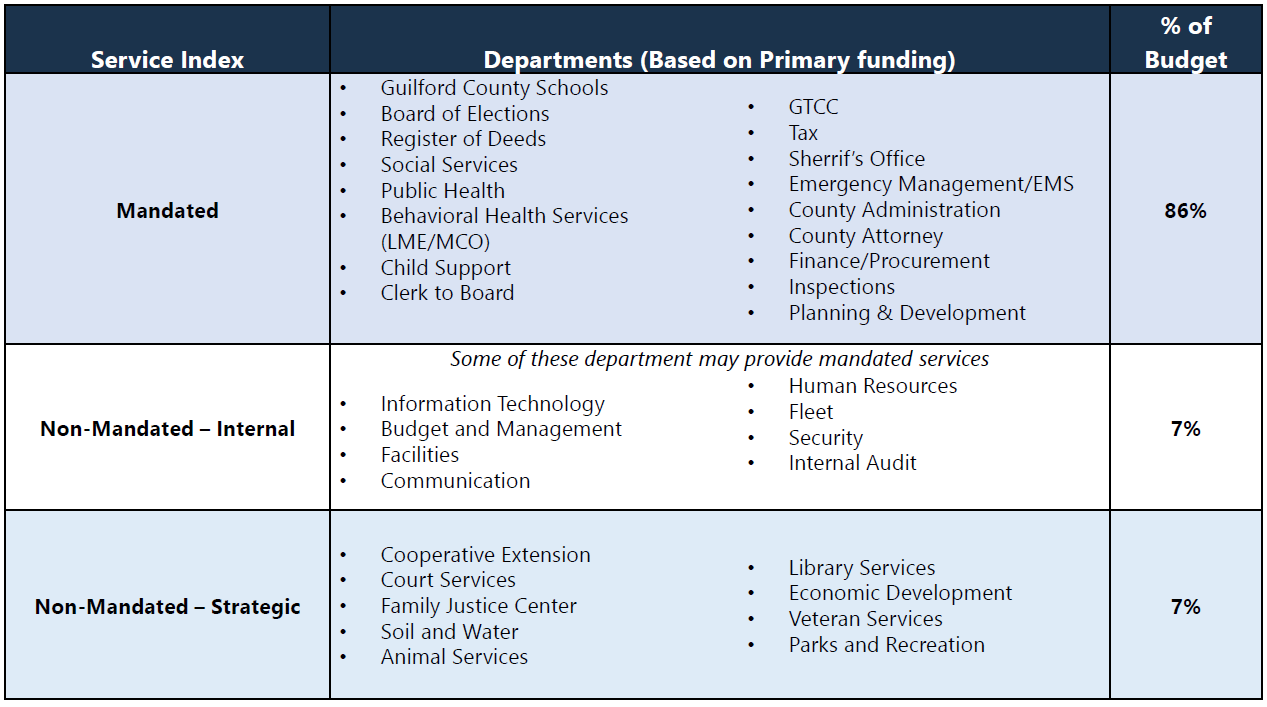
Which county services are mandated?
- A majority of what county government does is mandated in some form by the state.
- We have a responsibility to align resources to meet these statutory obligations.
- Continued alignment with public good and purpose.
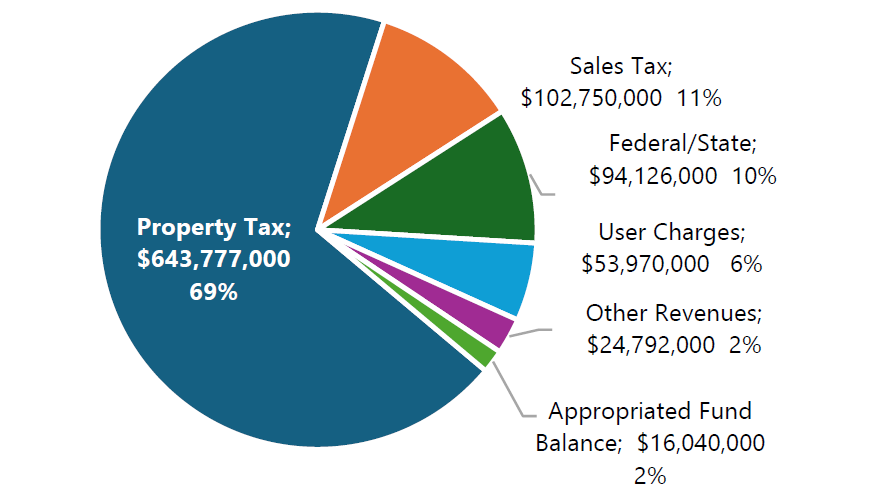
Where does Guilford County revenue come from?
- Property tax is a primary revenue source
- $13 million of natural recurring growth
- $89.3 million of additional revenue at the recommended tax rate
- Sales tax
- 0% growth over prior year budget
- 3.5% estimated growth over current year-end projection
- Federal and State funding
- 0.25% growth over prior year budget
- Mandates on county operations are growing, while funding is decreasing.
- HR-1 reduced the federal cost share for Food and Nutrition Services from 50% to 25%, a $3.1 million shift in federal responsibility to Guilford County
- User Charges
- Generates $54 million, a 0% change from prior year, with primary source being EMS Transports
- Growth is offset by reductions in Sheriff’s Office programs (SRO & Federal Inmate) and Elections
- Fee adjustments recommended in Inspections, Environmental Health, EMS, and Solid Waste
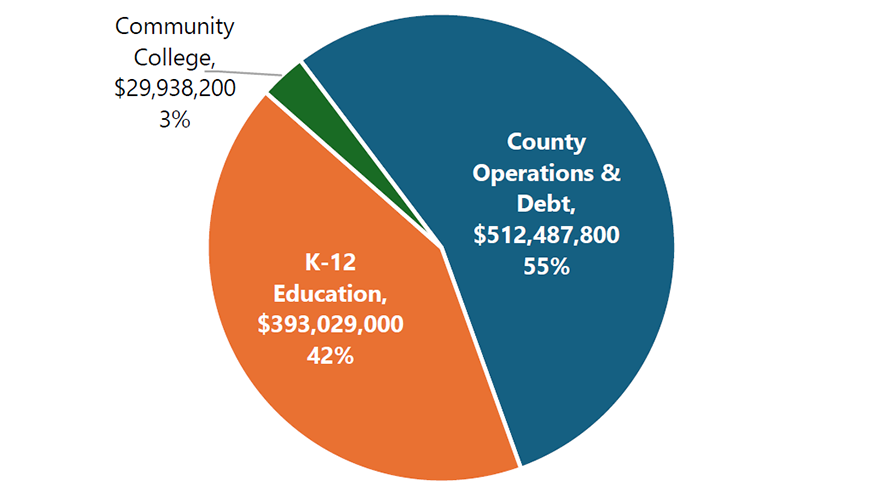
Where do Guilford County tax dollars go?
The county’s budget supports three major areas including K-12 education, community college and County operations.
o 55% of the budget is for County operations, including capital and debt
o 42% of the budget is for K-12 Education
o 3% if the budget is for Guilford Technical Community College
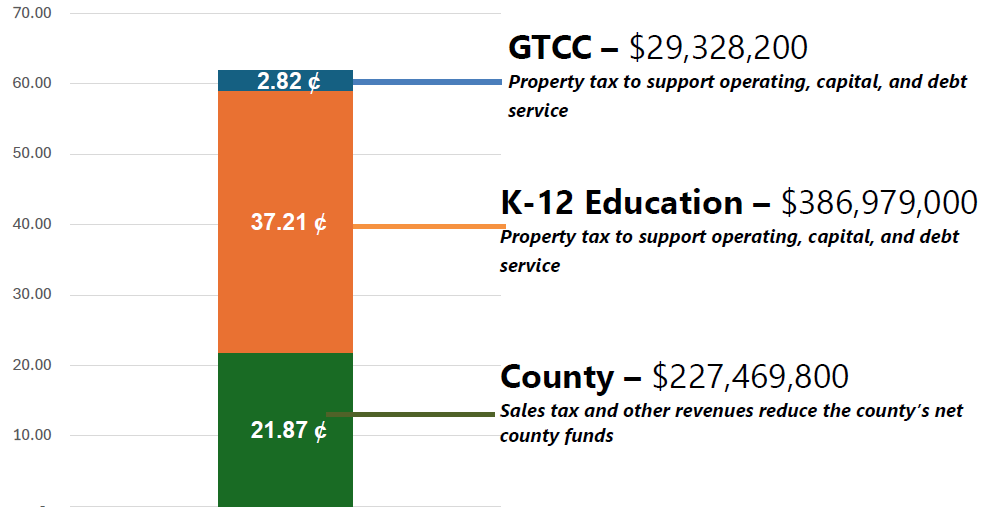
How much of property tax goes to each of these three major areas?
Recommended Tax Rate of 61.90 cents:
- 37.21 cents of the property tax goes to K-12 Education
- 21.87 cents of the property tax goes to County operations (Sales tax and other revenues reduce the county’s net)
- 2.82 cents of the property tax goes to GTCC
What does the tax rate above revenue neutral pay for?
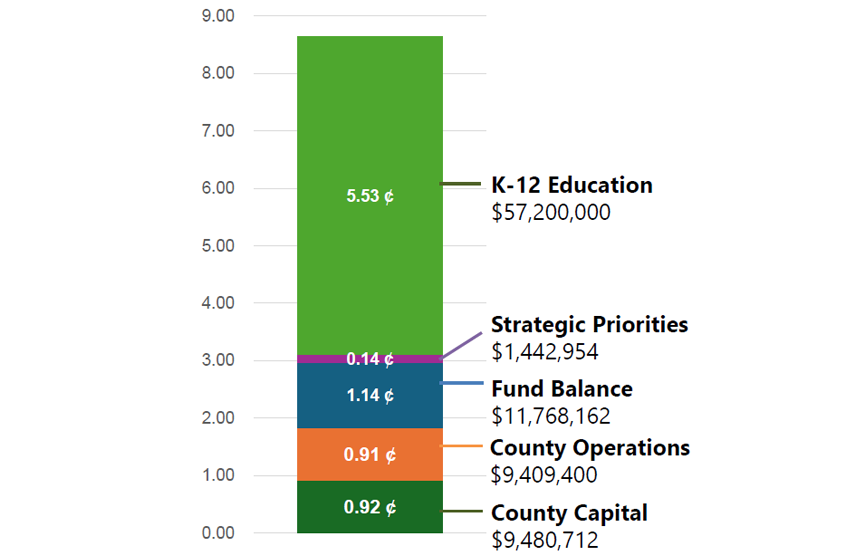
8.64 cents above revenue neutral will fund:
- K-12 Education
- Base growth of 2.8%, to support local operating expenses based on a multi-year funding strategy to promote predictability and cost control by establishing a school funding formula that aligns with consumer price index.
- $9 million for classified employee pay
- $1.8 million for safety and security
- $1.3 million for activity buses (not state funded)
- $5 million for student and staff technology
- $33.5 million for school capital debt service plan
- Stabilized, Responsive, & Strategic County Operations
- Structurally Balanced Budget
- Technology Enhancements (ERP) & Replacements
- Sheriff’s Office Body Cameras
- 28 New Positions
- 5-Year Capital Plan
- Sustaining Impactful ARAP Programs
- Eviction Mediation & Landlord Engagement
- Food Security Coordination
- Adult and Child High-Risk, Multi-Disciplinary Services
- Street Outreach & Family Shelter Supports
- Code Compliance Program
How does Guilford County support K-12 education?
- Achievements
- Funded construction and renovation of over 20 schools
- Improved safety and security at all 121 schools
- 5th in state in principal supplements, 3rd in assistant principal supplements, and 23rd in teacher supplements
- 9th in state in relative funding effort
- Funding
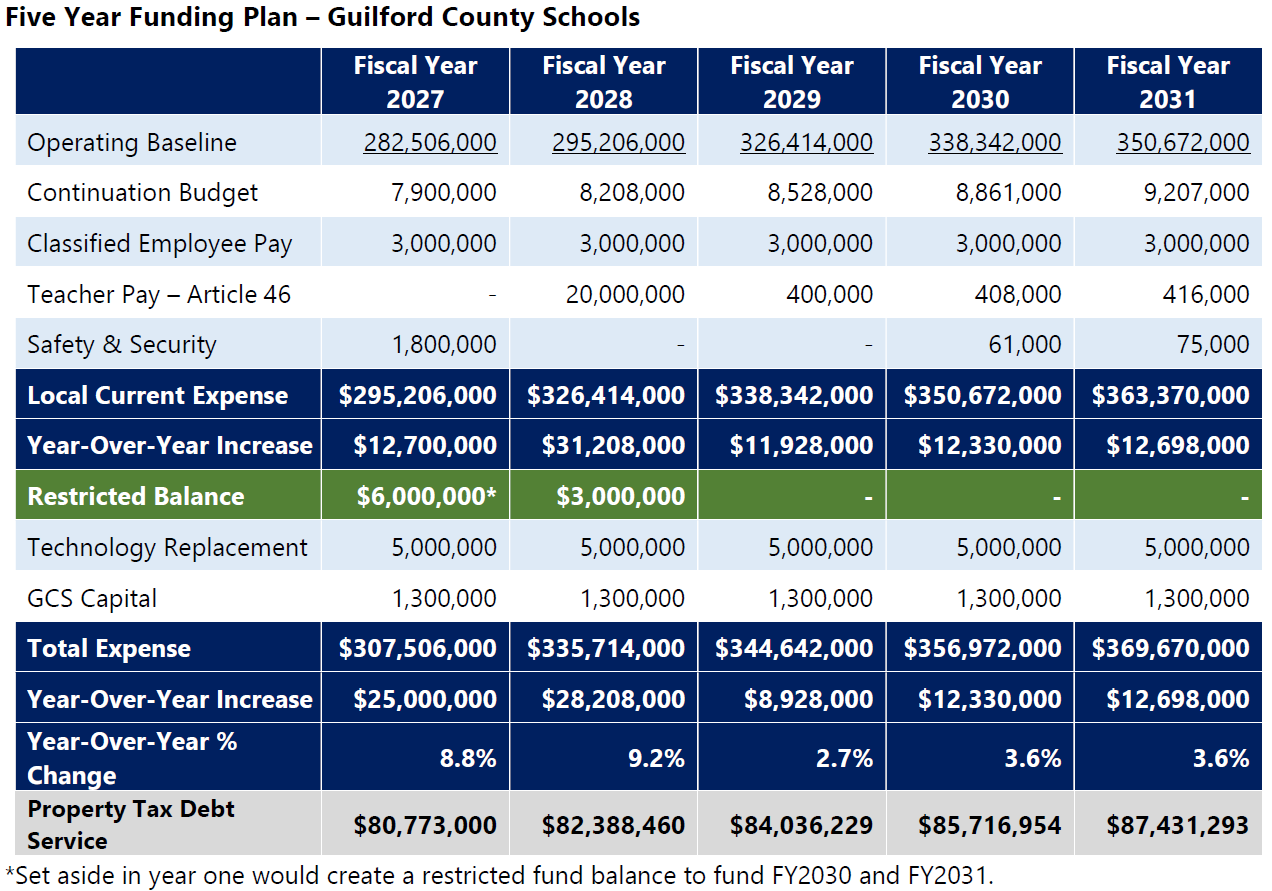
- $7.9 million for local current operating expenses (a 2.8% increase)
- $9 million in recurring funding to fund a 5-year phased pay plan for classified staff
- $1.8 million in recurring funding for safety and security enhancements
- $5 million in recurring funding to support a 1:1 technology program
- $1.3 million in recurring funding to support non-bond eligible capital needs
- $33.5 million in recurring funding to prepare for upcoming debt service obligations
How does Guilford County support local community college GTCC?
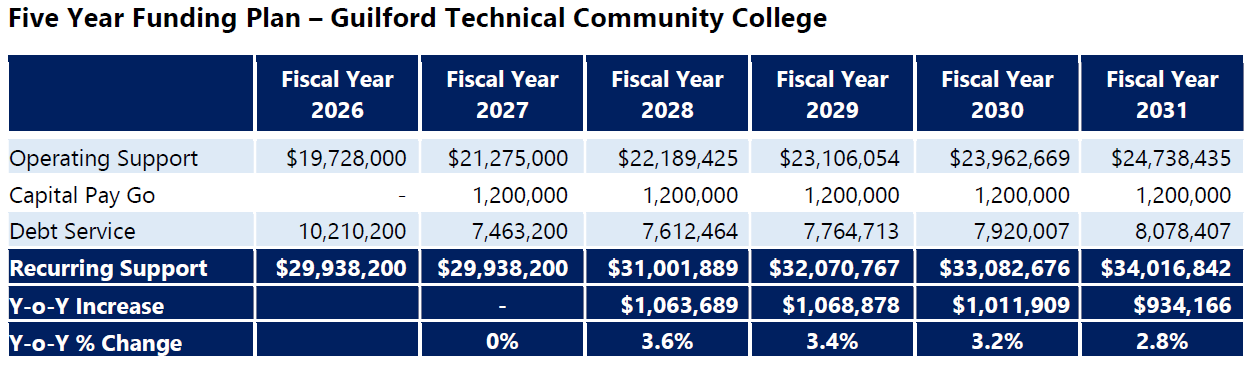
- Supports capital expansion to prepare workforce for economic development successes.
- Initial funding included with budget:
- Health Sciences ($16.5m)
- Skilled Trades ($5m)
- Bioprocess Manufacturing Technology ($4m)
- Center for Advanced Manufacturing ($1.9m)
- Future funding dependent upon other federal/state funding matches:
Aviation Building 2 ($30m)
What are population trends for Guilford County?
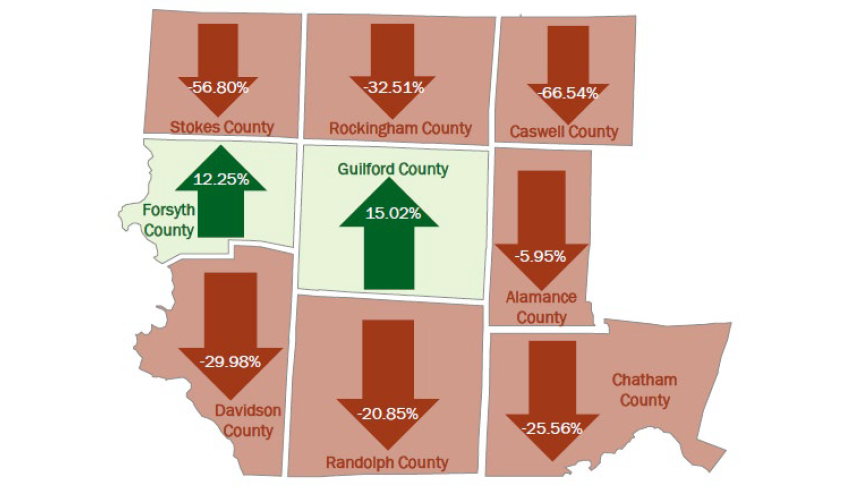
- #127 largest county in the United States
- 5% growth since 2020
- 558,000 residents
- 86,000 residents projected growth over next 20 years
- 138,629 daily inflow
What are the potential impacts for Guilford County if SB-899 (moratorium on property tax increase) becomes law?
- Results in no new funding for Guilford County Schools, including technology, security, and classified staff
- Limited funding for the school capital debt service plan and increased probability of tax rate increases or program discontinuation
- Results in no merit or compensation adjustments for county staff, including public safety
- Hold tax rates to prior year, resulting in a reduction of $4.2 million in funding for rural fire districts, meaning limited pay adjustments for first responders.
Revise economic incentive participation
FY2027 Recommended Budget FAQs
The total recommended budget is $935,455,000, while the proposed tax rate is 61.90 cents per $100 of assessed property valuation, which a reduction of 11.15 cents from the prior year. The recommended tax rate is 16% or 8.64 cents above the estimated revenue neutral tax rate of 53.26 cents. This is the lowest Guilford County tax rate in 20 years.
The revenue neutral rate is estimated at 53.26 cents per $100 of assessed property valuation. The revenue neutral rate would generate the same amount of revenue as the prior year, with a growth factor of 2.42%.
The recommended tax rate is 16% or 8.64 cents above the estimated revenue neutral tax rate to continue to help address community needs and county core services. During times of economic uncertainty, Guilford County can serve as a safety net for our residents. Additionally, supporting public education and serving a high volume of residents impacted by poverty through federally mandated safety net service remain as the leading cost driving during the budget planning process.
- 1.14 cents to preserve and manage fund balance reserves
- 0.91 cents to support core county operations
- 0.92 cents to support capital improvements and service optimizations including parks, greenways, and residential recovery.
- 0.14 cents to support the unhoused through street outreach, emergency sheltering, and eviction mediation.
- 5.53 cents to support K-12 Education
The recommended FY2027 budget is larger than the FY2026 budget because it maintains core county services while responding to growth, inflation, mandated service needs, education commitments, and long-term capital and technology needs.
The recommended budget includes a General Fund total of $935.4 million and reflects a balanced approach to what is required, what is demanded, and what is reasonable.
- It includes major investments in education, including $307.5 million for Guilford County Schools, a $25 million increase, plus $33.5 million for school bond debt service.
- It supports core services such as public safety, public health, social services, Medicaid administration, foster care, adult services, food security, and emergency response.
- It invests in future needs, including growth planning, GTCC workforce development projects, technology replacement, body-worn cameras, and county facility and capital needs.
- It continues support for residents through libraries, eviction mediation, street outreach, family emergency sheltering, digital literacy, aging-in-place efforts, and code compliance.
- The budget also strengthens fiscal health by reducing the use of fund balance from $17.8 million to $10 million, while lowering the recommended property tax rate by 11.15 cents from the prior year.
Guilford County has developed an alternate recommended budget if property tax assessments are paused for a year. Natural growth of $11 million will not fully fund all identified priorities. This could result in no new funding for Guilford County Schools, including technology, security, and classified staff. In addition, county staff, including public safety employees, will not receive merit or compensation adjustments. Lastly, the revenue loss will result in flat tax rates for rural fire districts, meaning limited pay adjustment for first responders.
In keeping with strong fiscal stewardship, the County conducted a comprehensive review of all departmental expenditures and implemented cost-control strategies. As a result, more than $3.7 million was reduced from the operating budget.