
What is Property Tax Reappraisal?
Property tax reappraisal in North Carolina is a comprehensive and data-driven process in which counties reassess and assign updated values to all real property based on its current market value. This process involves analyzing recent sales data, reviewing market trends, evaluating property characteristics, and considering neighborhood and market area conditions to ensure each parcel is assessed fairly and uniformly.
Reappraisals are conducted in accordance with North Carolina General Statutes, must be conducted at least every eight years, and are designed to maintain equity across the tax base so that property owners pay their proportionate share based on what their property would likely sell for in an open and competitive market.
The Reappraisal Process
Reappraisal is an in-depth process of appraising all the real property in the county at its current market value. The 2026 reappraisal includes using county maps, aerial photography, street-level images, sales analysis, field visits, and other tools to gather data to determine market value. Guilford County appraisers will review and analyze the information, including comparable sales within your neighborhood.
Reappraisal is not only mandated by the North Carolina General Statutes, but it is necessary to maintain equitable and uniform property values among property owners throughout the county. Reappraisal notices will be mailed out early 2026.
Staff appraisers who are certified by the NC Department of Revenue and/or licensed by the NC Appraisal Board.
- The new values become effective Thursday, Jan. 1, 2026.
- Property owners will be notified in February 2026.
- Your new values will be reflected on the tax bill you receive in July 2026.
- It is the most probable or most likely price that the property would sell for. It is not the highest, lowest, or average price.
- It is expressed in terms of money.
- It requires a willing buyer and a willing seller with neither under any pressure to buy or sell.
- It implies that the buyer and the seller are fully informed of all the purposes for which the property is best adapted and is capable of being used.
- It recognizes the property’s current use as well as its potential use.
- We collect and analyze sales data from real estate transactions in the county.
- Appraisers must recognize values created by arm’s length sale transactions in neighborhoods.
- We analyze basic characteristics on every property such as a building’s total square footage, type and quality of construction, type of heating and cooling, bathroom count, age, condition, usefulness, etc.
Property values will not change uniformly throughout the county. Depending on market conditions and recent sales in your neighborhood, your assessed value may increase, decrease, or remain relatively the same.
We use the appraisal industry's valuation methods, including:
Market Approach: Compare property to recent sales of similar properties.
Cost Approach: Determine the current cost of replacing the property.
Income Approach: Consider how much income the property could produce (usually used for commercial properties).
The reappraisal determines only one of the two components of your tax bill -- the assessed value. The other component, the tax rate, is set by our elected officials such as the County Commissioners or your City Council.
The 2026 tax rates will not be set until June 2026. Elected officials will determine how much revenue will be needed to operate during the upcoming fiscal period that runs from July 1, 2026, until June 30, 2027.
The reappraisal is done for all residential, commercial, and industrial land and structures in Guilford County. The reappraisal does not include personal property such as motor vehicles and boats whose values are adjusted annually.
The appeal period is now closed.
The appeal deadline was May 15, 2026 at 5 p.m. EST.
Why is Guilford Conducting a 2026 Reappraisal?
In April 2023, the North Carolina Department of Revenue (NCDOR) required Guilford County (population greater than 75,000) to conduct a 2026 property reappraisal because the majority of properties were selling for more than their assessed value, also known as market value. View the requirement letter. The goal of a reappraisal is to ensure that all property values are accurate and that the property is selling, or would sell, for its true worth.
Reappraisal tools include county maps, aerial photography, street-level images, sales analysis, field visits, and other methods for gathering data to determine market value. Guilford County conducts reappraisals entirely in-house by appraisers familiar with the local market.
Reappraisal Timeline
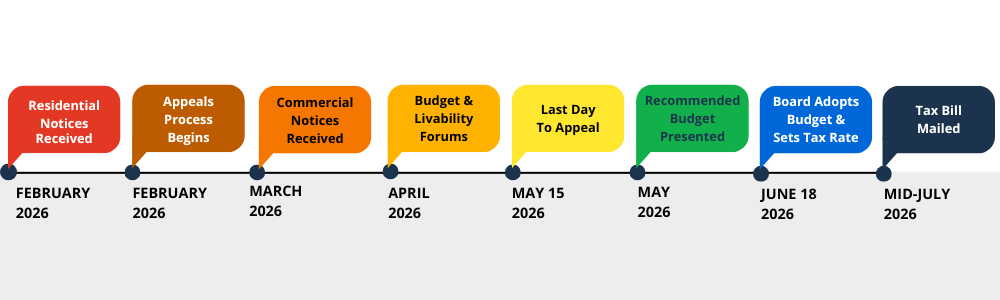
Ensuring Accuracy as a Property Owner
Guilford County values accountability, transparency, and communication. Tools are available to provide education, awareness, and advocacy during the reappraisal process.
Comper Citizen is a property information and sales-comparison tool that helps clarify and strengthen the property assessment process more clearly and more trustworthy. Property owners can see their assessed value, check the sales used for comparison, explore local market trends, and learn how assessments are set. This helps taxpayers make informed choices and feel more confident if they need to appeal. View the Comper Citizen tutorial video.
Assessed Valued Increase Calculator quickly calculates the percentage change in a property’s assessed value since the last reappraisal, helping property owners easily understand how much their assessment has changed. You can find your current value on your Notice of 2026 Real Estate Assessed Value. Your prior value can be found on your prior year’s tax bill, available on the county’s website under “Tax Bill” and then 2025.
Appeal Pro is an online platform that makes the property tax appeal process easier for both property owners and appraisal staff. Taxpayers can submit appeals and documents online and communicate securely. Appraisers can review, manage, and resolve appeals more efficiently and transparently.
Supporting Documents for Appeals
Please find below examples of supportive documents for a property reappraisal appeal that will support your opinion of value.
For Residential Appeals
- Recent sales comparables
- Evidence of physical issues
- Existing Recent Appraisal
- Square footage/property record card errors
- External factors, such as flood zone
For Commercial Appeals
- Recent Appraisals
- Documentation of damage or unusual wear to the property
- Documentation of contamination on the property
- Information on recent sales of the appealed property or other similar properties
- Income and expense statements for the property



Assessed Value Increase Calculator
Input your previous assessed value and new assessed value to calculate the percentage change of your property.
*If your property had a reassessed value in 2023, 2024 or 2025, due to major changes (such as those requiring a building permit) then enter your appraisal value from that year.
If you have questions or need help, email us at taxappraisal@guilfordcountync.gov or call 336-641-4814.